Driveway Gates · 6 min read · Updated 2 September 2026
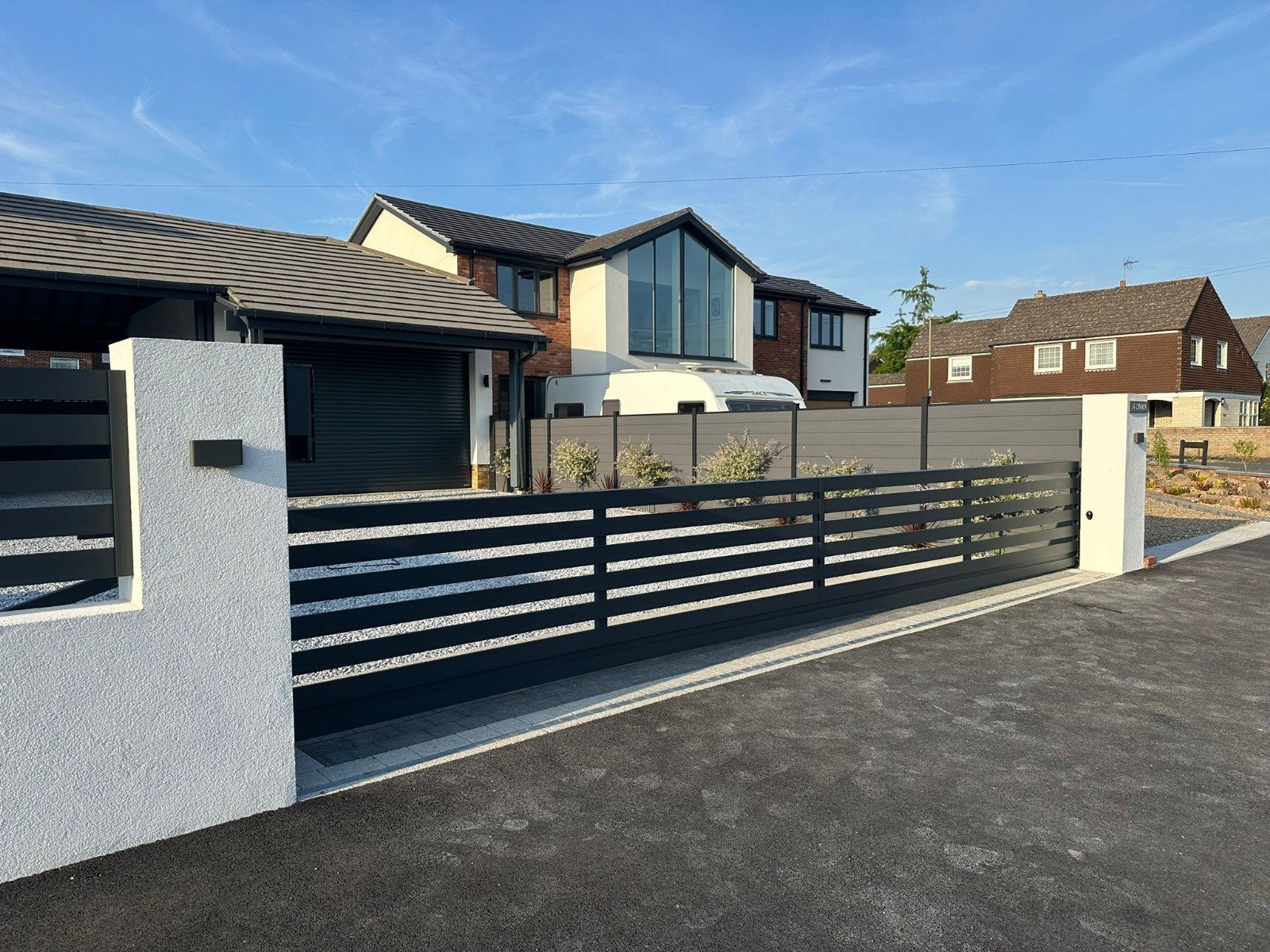
Sliding vs Swing Driveway Gates: Which Suits Your Driveway
Almost every driveway gate enquiry starts with a style. It should start with the geometry of the opening, because that decides which gates are even possible.
Choose sliding when
The driveway slopes up or down away from the road.
The approach is short and a swinging leaf would block the pavement or a parked car.
The opening is wider than about 4 metres.
You want the shortest possible opening time on a wide entrance.
Choose swing when
The ground is level and there is clear run-back either side.
You want a traditional pair of leaves with a decorative top profile.
There is no side space alongside the opening for a sliding leaf to park.
Budget matters and the opening is modest — swing hardware is usually cheaper.
Cantilever sliding gates
A cantilever gate runs on a beam and rollers set back from the opening, so there is no ground track to fill with grit, leaves or snow. It costs more than a tracked gate and needs a foundation to one side, but it is the most reliable sliding arrangement in UK weather.
Why aluminium changes the calculation
Weight decides how hard the automation has to work. An aluminium leaf is a fraction of the mass of a steel or timber equivalent, which means smaller motors, less wear on rollers and hinges, and a gate that still moves smoothly years later.
Frequently asked questions
Which is more secure, sliding or swing?
Both are secure when built and fixed properly. Sliding gates cannot be forced open against a slope or wind in the same way, but the locking hardware and post fixing matter far more than the type.
How much side space does a sliding gate need?
As a rule of thumb, roughly the width of the opening plus an allowance for the counterweight on a cantilever design. We confirm this on the survey.
Can a sliding gate be automated later?
Yes, but duct the cable run and set the foundation for the motor at the time of install — retrofitting after the driveway is laid is the expensive route.
Begin Your Project Today With a Team You Can Trust
Whether you're planning a new metal garage, gate, shed, or outdoor structure, AlumaGates is here to guide you every step of the way. We focus on clear communication, dependable service, and delivering durable results that meet your expectations.